Haut Benauge
Bordeaux Haut Benauge is a little known appellation that makes botrytized sweet white wines as well as reds. The dry white wines made there come under the Entre Deux Mers Haut Benauge appellation. Little known Haut Benauge may be, but it certainly has a distinguished past and there are remnants scattered of it throughout the tiny, vine enclustered communes.
The Haut Benauge appellation was created in 1927 at Ladaux and defined by decree by the INAO in 1955. Haut Benauges takes its name from the Château de Benauge, the seat of the Viscount who governed the region. Ladaux is the seat of the oldest wi
ne growing union in France dating back to 1925.
The Château Benauge is now ruined but nevertheless is still an imposing sight perched on the hill at Arbis, dominating the region between Cadillac and Targon. Its strategic position gave it a crucial role in the Middle Ages and it is still one of the regions most beautiful medieval fortresses. The first tower was constructed in the 11th century by the Viscount Benauge and the château then passed to the de Grailly family in 1266. Jean I de Grailly was the Seneschal of the Duchy of Gascony and of the Kingdom of Jerusalem. He was a knight of the household of King Edward I of
England and was rewarded for his services with the gift of the château and viscounty of Benauges. Benauges was the last bastion to fall to the French when they won the Hundred Years War in 1453 and the English finally lost Bordeaux.
There are 9 wine making communes in Bordeaux Haut Benauge: Targon, Soulignac, Escoussans, Ladaux, Cantois, Arbis, Saint Pierre de Bat, Gornac and Mourens. The little communes are dotted with ancie
nt churches – they lie less than 5 miles away from the Abbey of Saint-Gerald de la Sauve Majeure whose Benedictine monks made wine for centuries alongside those of Sainte Croix du Mont.
Saint Gerald founded the Abbey of Sauve Majeure in 1079, of which he was also the first abbot. Its name refers to the Silva Major, the great forest that then occupied the whole region known as the Vignoble de l'Entre-Deux-Mers ("vineyard between two seas"), which was a gift to Gerald from Duke William VIII of Aquitaine. With the support of the duke
, the Pope and a large number of generous benefactors and protectors, including the kings of England, its patrons, and France, the abbey prospered and grew rapidly. It is sited on the route to Compostela and served as a local point of departure for pilgrims. In the Middle Ages it was a rich and powerful house and possessed 51 priories, including one at Burwell in England. Eleanor of Aquitaine – the Queen who brought claret to England - stayed there often.
Most of the communes are surrounded by vines and water mills run along the rivers – some of which are fortified. Targon is home to the 12th century Church of Saint Romain and the Templar remains of the Church of the Commandery of Montarouch built in 1153. Cantois takes its name from the Latin "Cantus" meaning bird song and is home to the Church of Saint Seurin which has the oldest church bell in the Gironde. Soulignac lies on a
Gallo-Roman estate that belonged to a certain Solhemnius or Solenius and in 1946 Roman treasure was discovered there. This consisted of 33 kg of bronze coins and silver with the effigies of Valérie-Galien and its more than Tétricus, Governor of Aquitaine from 255 to 355 AD.
Saint Pierre de Bat lies on ancient springs and there are old wash houses and watering places in the village. A statue of Saint-Pierre-és-Liens with his hands tied stands at the entrance of the village and a 17th century dwelling there once housed Louis XIV when he passed through the area. Escoussans lies in a charming valley, south-west of Targon and
owes its name to the first Lords who settled there, at the beginning of the 12th century. The House of Escoussans disappeared around 1350 and its property then passed to the House of Albret – one of the most powerful feudal families in medieval France. The Lords of Albret distinguished themselves in the local wars of that epoch; changing sides during the 14th century to support France against the English. They became Kings of Navarre and Jeanne d'Albret became the mother of Henry IV, King of France – quite a dynasty!
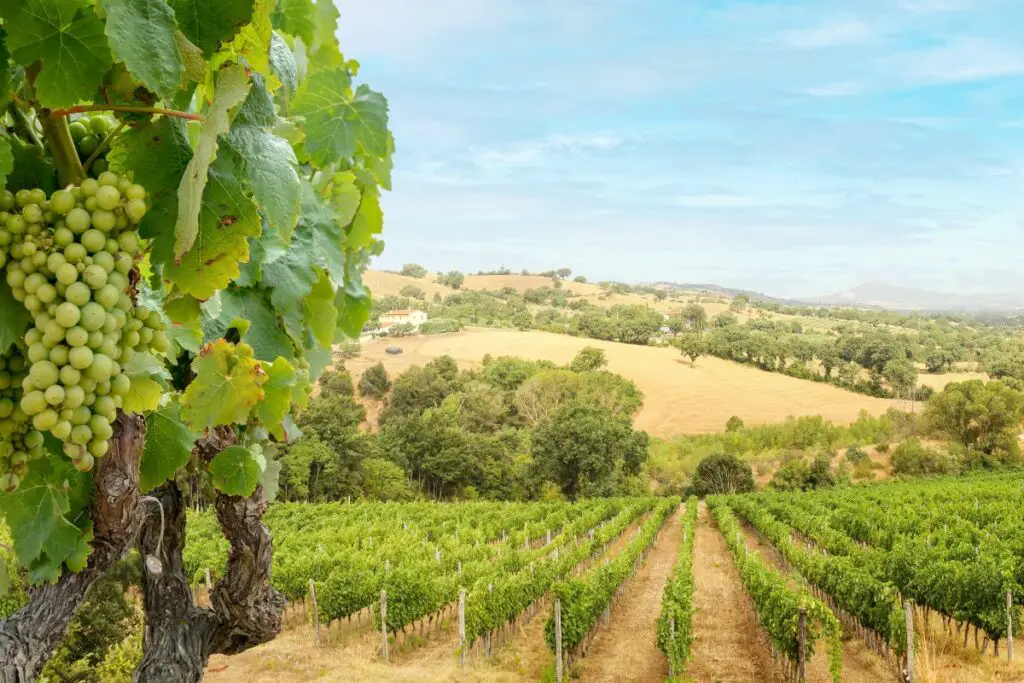
It's a shame that Haut Benauge is not more widely known – but perhaps therein lies its beauty. It lies directly across the Garonne River from Graves and because Haut Benauge occupies high ground, it is considered one of the best grape-growing parts of this vast region. Drainage and exposure are excellent and its wines are long and perfumed. They are mellow and creamily smooth with notes of caramelized fruits and honey. Haut Benauge wines can be enjoyed young but age well and develop in subtlety. If you spot one – and they are difficult to find – try it and see what you think!
Â